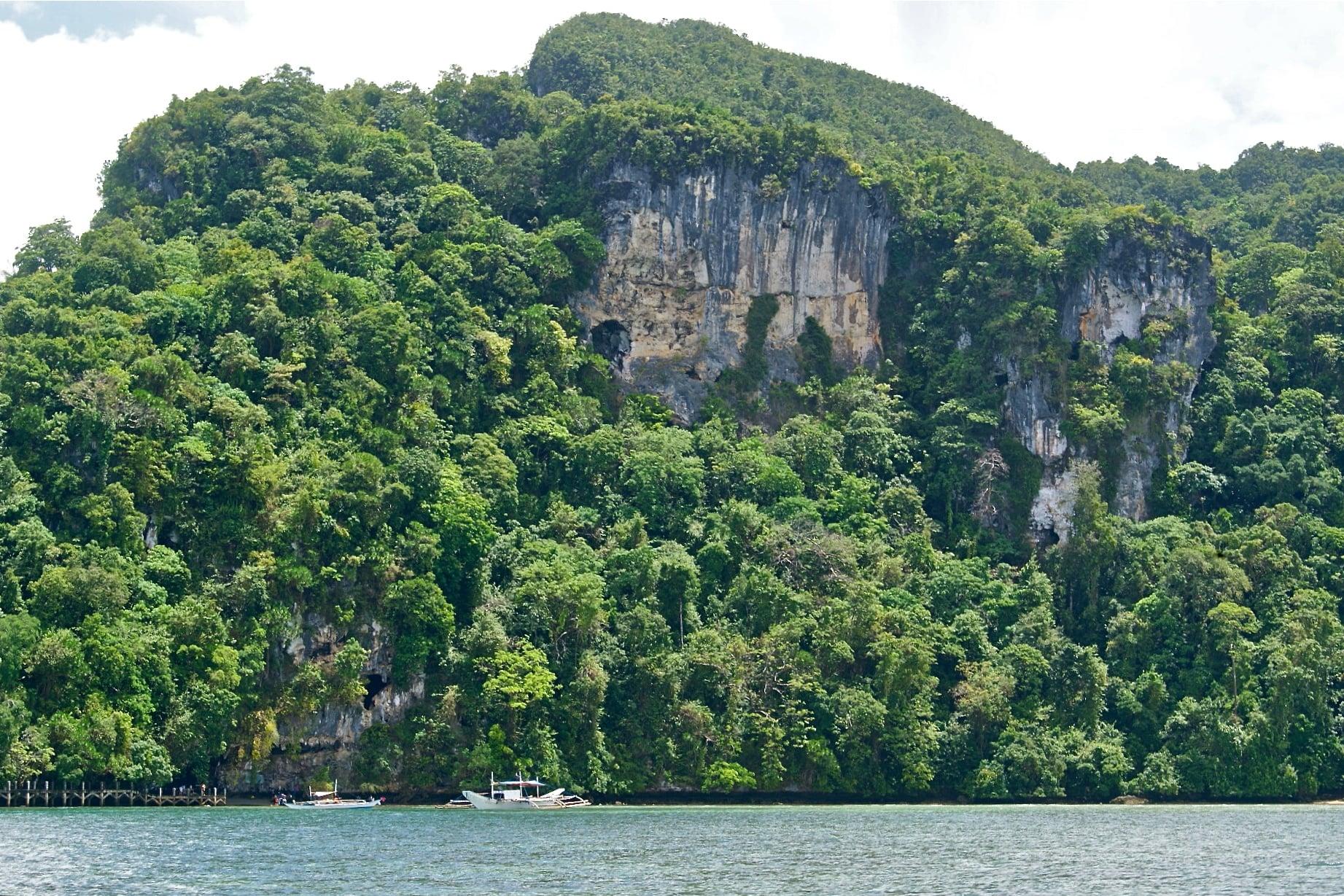
The Tabon Caves sit at Lipuun Point near Quezon town, a limestone headland riddled with roughly 218 caves, of which some 38 have archaeological or anthropological importance.
In 1962, National Museum archaeologist Robert Fox found a human skullcap here later dated to about 16,500 years old, along with a leg-bone fragment dated to roughly 47,000 years, the oldest known human remains in the Philippines. The site is often called the country's cradle of civilization for the depth and span of its jar-burial and habitation record.
Only Tabon Cave itself, the largest and most accessible of the complex, is generally open to visitors, reached by a boat crossing from Quezon town followed by a walk up to the cave mouth; a site museum at Lipuun Point explains the wider excavations.
- Best time
- November to May, dry season, for easier boat access and walking
- Getting there
- By van from Puerto Princesa city to Quezon town, then a short boat ride to Lipuun Point
- Nearest gateway
- Puerto Princesa International Airport
- Where
- 9.280° N, 117.981° EOpen in Google Maps
Tabon Caves and Quezon
Keep scrolling and they travel past. Press one to see it whole.
Quezon, the town
Quezon is a coastal town of southern Palawan on the South China Sea side, which the Philippines calls the West Philippine Sea, 146 km from Puerto Princesa. Its waters hold a population of the critically endangered Irrawaddy dolphin.
The municipality is home to the Tabon Caves, where the remains of Tabon Man were found, and it shares Mt. Mantalingahan Protected Landscape with its southern neighbours.
Getting to Quezon
- From Puerto Princesa
- By road, 146 km.
The local government
- Mayor
- Lily Torrico
- Vice mayor
- Leonard Vincent Ayod
- Municipality of
- Quezon
- PSGC code
- 1705317000
- Barangays
- 14
- Land area
- 943.2 km²
Elected on 12 May 2025 for the term to 30 June 2028, named as on the ballot, from the count COMELEC released (via Rappler); checked 9 November 2026. An official can be suspended or replaced during a term, so the town hall has the last word.
In an emergency
Call 911Quezon’s disaster office (MDRRMO): 0917-137-5223
From the provincial emergency page, checked 8 November 2026. Every emergency number
Its people and its past
In 1962 a team led by the anthropologist Robert Fox excavated the Tabon Caves at Lipuun Point and recovered human fossils some 22,000 to 24,000 years old; the caves also yielded the Manunggul Jar. The old name of the town, Tabon, comes from the tabon bird.
Quezon was created in 1951 from barrios of Aborlan and Brooke's Point. Indigenous highland communities, among them the Tau't Bato and Tagbanua, keep their own beliefs, and some Palawano and Molbog families are Muslim.